



Last updated on February 23rd, 2026
eCommerce involves operations, customer experience, marketing intelligence, logistics coordination, and sometimes even brand identity itself. When you choose an eCommerce platform, you are choosing a foundation that must hold the weight and the changes your business demands.
There are many platforms in the market. Among the most discussed are Shopify and the Magento eCommerce Solution. Both are powerful in their own way, yet they serve different types of businesses with different ambitions.
In this article, we will look closely at why Magento eCommerce development continues to stand strong in 2026. Magento holds around 7–8% of the global e-commerce platform market share, ranking it as one of the top three e-commerce platforms worldwide. We will compare it thoughtfully with Shopify and outline five substantial reasons why the Magento eCommerce platform may be the better long-term choice for businesses.
Table Of Contents
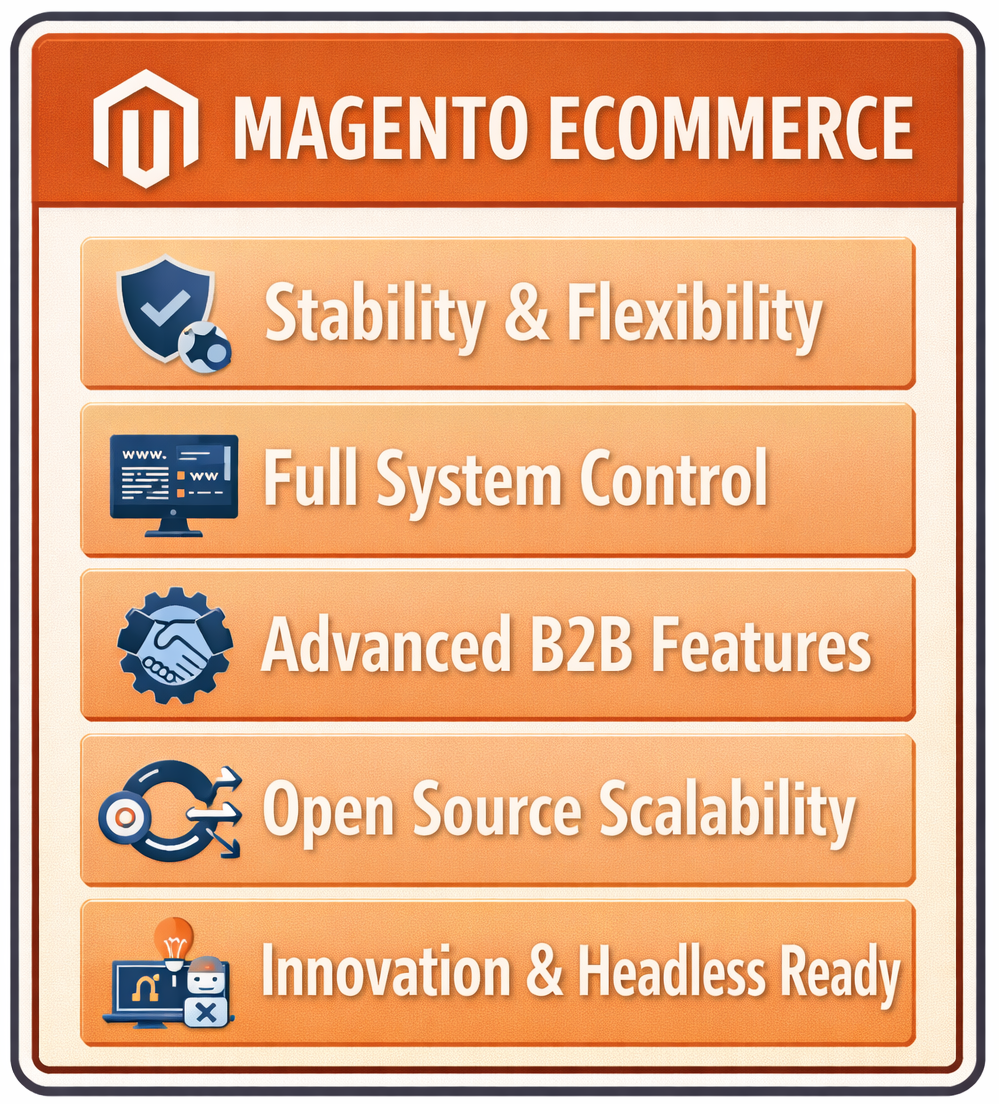
Stability and Flexibility in Magento eCommerce Development
Control Within the Magento eCommerce System
B2B eCommerce with Magento eCommerce Platform
The Flexibility and Scalability of Open Source Magento eCommerce Solution
Innovation and Future Readiness with Magento eCommerce Development
1. Stability and Flexibility in Magento eCommerce Development
In industries where rules are tight and competition is fierce, stability is not a luxury. It is survival. When product catalogs stretch endlessly, and every item has layers of details, stability is essential. At the same time, flexibility cannot be sacrificed. Markets change their minds quickly, and customers change even faster.
This is where the Magento eCommerce Solution steps in. It is steady and built for the long run. It stands on a stable architecture that can carry heavy traffic and large catalogs without panic. Complex pricing structures are also tackled with ease. It does not wobble when operations become complicated.
But here is the interesting part. While it stays strong at the core, Magento eCommerce development lets businesses bend the system to their will. You can shape it and adjust it to match how your industry actually works.
This matters a lot in sectors like pharmaceuticals, automotive, manufacturing, or luxury goods. These industries are not simple. Products come with configurations, compliance documents, pricing tiers, and fine details that cannot be ignored. The Magento eCommerce system handles that complexity with composure. It organizes everything with ease.
Shopify, on the other hand, is quick and easy. It feels smooth at the start. But for businesses that need deep customization or industry-specific workflows, its structure can start to feel small.
Magento’s customizable framework offers something different. It brings resilience and adaptability. And for enterprises that cannot afford limits, that balance makes all the difference.

2. Control Within the Magento eCommerce System
Control keeps everything steady. And in regulated industries, that quiet control matters a lot. Companies must manage hosting environments, security protocols, data access, and third-party integrations carefully. One loose end can become a big problem. So control is like protection.
The Magento eCommerce Solution gives businesses more control over the entire technology stack. They can choose their hosting provider. They can set up tailored security configurations. They can connect specialized software systems. They are not boxed inside a closed ecosystem. That freedom supports compliance. It helps companies align with regulatory frameworks and internal IT policies without compromise.
With Magento eCommerce development, organizations can reshape backend processes. They can customize APIs. They can build workflows that actually match how their operations run. This level of control reduces vulnerabilities. It improves data governance. It strengthens cybersecurity measures.
Shopify takes a different road. It runs inside a SaaS framework. That makes maintenance simple and convenient. For small to mid-sized businesses, that simplicity works well. But when deep customization or advanced integrations are required, the walls can feel close.
The Magento eCommerce system allows independence. When regulations change or markets shift, businesses do not have to wait for platform updates. They can adjust on their own timeline. And that quiet ability to act fast can become a measurable competitive advantage.

3. B2B eCommerce with Magento eCommerce Platform
B2B eCommerce is not like B2C. It plays by different rules. There is bulk pricing. There are negotiated contracts. Orders are large, and they repeat. One company may have many buyers under one account, and purchases often need approval before money moves. It is serious business.
The Magento eCommerce platform understands this language. It supports complex pricing rules. It allows customer-specific catalogs, and it manages account hierarchies without confusion. A company can have multiple buyers under one corporate profile, each with defined roles. This makes wholesale buying organized, not chaotic.
With Magento eCommerce development, businesses can build volume-based pricing structures. They can create custom quotation systems. They can offer flexible payment terms. These features matter in industries where each transaction is significant and long-term relationships are more important than one-time sales.
Shopify has added B2B features over time. But when it comes to depth and flexibility, Magento still reaches further. For wholesale, distribution, and manufacturing sectors, it often feels more natural and capable.
The Magento eCommerce system also connects smoothly with ERP systems, CRM platforms, and inventory management tools. That means fewer manual tasks, fewer errors, and better coordination. In high-volume B2B environments, this kind of integration is essential. B2B is complex, and Magento simply handles it well.
4. The Flexibility and Scalability of Open Source Magento eCommerce Solution
The quiet power of the Magento eCommerce Solution begins with one simple idea: open source.Open source does not just mean “you can see the code.” It means you are not locked in.
With Magento eCommerce development, businesses can change the source code. They can build custom modules. They can create features that match their brand’s personality and their operational complexity. Especially in niche industries, this freedom matters. Some businesses need tools that do not exist in standard eCommerce packages. Magento allows them to build those tools instead of settling.
There is also a large global developer community behind Magento. Thousands of experts create extensions, plugins, and performance upgrades. Innovation keeps moving. It does not freeze. Businesses can use these improvements and grow with them.
Then comes scalability in the future. As a company grows, its platform must grow too. The Magento eCommerce platform is built for that. It can scale horizontally and vertically. It can support more traffic, bigger catalogs, multiple countries, more currencies, and more complexity.
When seasonal traffic spikes hit, or flash sales explode, or global campaigns go live, weaker systems can struggle. The Magento eCommerce system can be optimized for pressure. With content delivery networks, advanced caching strategies, and performance tuning, it stays steady when demand rises. Magento is built to stretch without breaking.
5. Innovation and Future Readiness with Magento eCommerce Development
Innovation is important for digital commerce. Customers change their minds quickly. They expect faster pages, smarter search, and personalized offers. Platforms must keep up, or they will fall behind quietly. The Magento eCommerce Solution is built with this reality in mind.
It supports modern trends like headless commerce, progressive web applications (PWAs), and AI-driven personalization. Headless architecture simply means this: the frontend design and the backend operations are separated. The result is more creative freedom. There are more immersive user experiences and fewer design limits.
With Magento eCommerce development, businesses can go deeper. They can build PWAs. They can improve mobile performance. They can deliver app-like experiences directly through web browsers. It feels smooth for customers and flexible for brands. Companies can test ideas, adjust features, and experiment without being restricted by rigid structures.
Inside the Magento eCommerce system, artificial intelligence tools can support predictive search, dynamic pricing, and customer behavior analysis. The platform can learn from shoppers. It can adjust and recommend. This leads to better engagement and stronger conversions.
Shopify does offer innovation, yes. But its SaaS structure can make deep backend customization more difficult. For businesses that want convenience, that works well. For organizations that want experimentation and technological leadership, Magento often feels like the more forward-looking path.

Frequently Asked Questions
1. Is Magento suitable for small businesses?
Yes, Magento can support small businesses, but it is particularly beneficial for companies expecting rapid growth or requiring advanced customization.
2. How does Magento differ from Shopify?
Magento offers greater flexibility and control, while Shopify provides simplicity and ease of use within a managed environment.
3. Is Magento secure for eCommerce operations?
Yes, the Magento eCommerce system supports robust security configurations and allows businesses to implement additional protective measures.
4. Can Magento handle international eCommerce?
Yes, the Magento eCommerce platform supports multiple currencies, languages, and tax configurations for global operations.
5. Is Magento scalable for enterprise-level traffic?
Yes, Magento eCommerce development supports high scalability with appropriate hosting and performance optimization strategies.
Conclusion
Choosing an eCommerce platform shapes the future of your digital operations. Shopify offers convenience and simplicity. But when it comes to complex businesses, the Magento eCommerce Solution delivers flexibility, control, scalability, and innovation.
From B2B functionality to open-source adaptability, from deep customization to technological independence, Magento eCommerce development accommodates it all. It provides a framework that evolves alongside your business rather than restricting it.
Magento is ideal for organizations operating in regulated industries, managing complex catalogs, or planning international growth. The Magento eCommerce platform presents a compelling and future-ready solution.
At VserveeCommerce, we specialize in delivering powerful Magento eCommerce development solutions tailored to complex business needs. Our team helps you build a secure, scalable, and performance-driven Magento eCommerce system designed for long-term growth.
Partner with VserveeCommerce today.
Suggested Reads
https://www.vserveeCommerce.com/blog/devops-and-testing-tools-for-magento-development/ – Essential tools ensuring stable Magento deployment cycles
https://www.vserveeCommerce.com/blog/how-ai-magento-agencies-balance-automation-and-strategy/ – Balancing AI automation with human eCommerce strategy
https://www.vserveeCommerce.com/blog/magento-website-crashing-high-traffic-events/ – Preventing Magento crashes during high traffic surges
https://www.vserveeCommerce.com/blog/custom-magento-development-guide/ – Comprehensive guide to custom Magento development solutions

