


Last updated on January 30th, 2026
eCommerce is constantly asking you to rethink your business. In 2026, building an online store is not as simple as setting it up and selling products. It is more about creating a unique and satisfying shopping experience for your visitor while your brand reaps the rewards in sales.
There are countless platforms out there. However, three names still keep popping up regularly: Shopify, WooCommerce, and BigCommerce. Each has its own persona. Choosing among them is less about right or wrong and more about what kind of future you wish for your store.
Shopify and WooCommerce dominate ecommerce platform usage, with Shopify used by around 27% of all ecommerce sites and WooCommerce powering about 14% of online stores, highlighting their widespread adoption for store development projects.
In this blog, we will compare Shopify store development, WooCommerce store development, and BigCommerce store development. We will discuss key factors, keeping things quite simple and practical.
Table of Contents
Usability in Shopify, WooCommerce, and BigCommerce Store Development
Security in eCommerce Platforms
Customer Support and Reliability
Functionality That Powers Your Store
Pricing in 2026: What You Really Pay
Customization Potential Across Platforms
Frequently Asked Questions (FAQ)
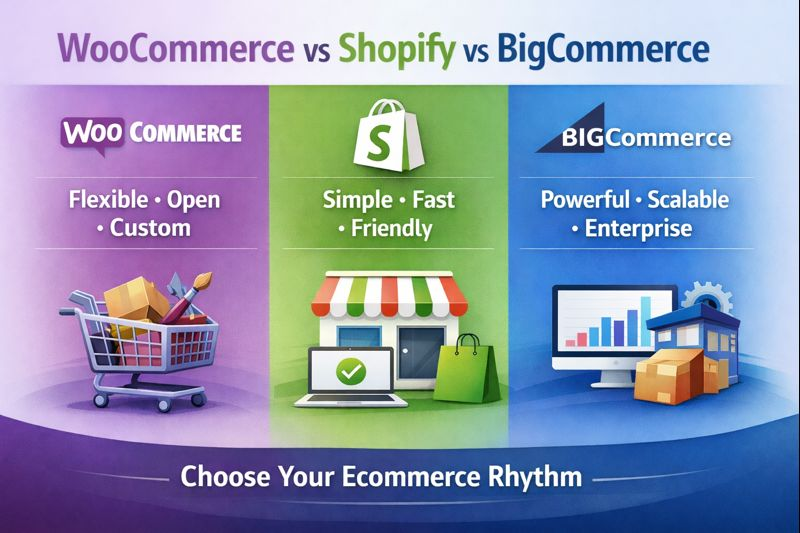
Comparison of Key Features
Let’s go into the details and see how these three platforms behave when put to work in the real world or in daily digital life.
Usability in Shopify, WooCommerce, and BigCommerce Store Development
Usability is where your relationship with a platform begins. It is the moment you decide whether to stay or try another option.
Shopify store development is known for its quite smooth welcome. It is remarkably easy to set up, even for those who fear buttons and settings panels. The interface is friendly, and the themes are ready-to-wear. Most of the heavy lifting happens quietly in the background. It does not ask you to be technical. It asks you to be decisive.
BigCommerce store development is a slightly more serious task at hand. It offers deeper built-in features and stronger native capabilities than Shopify. It requires a steeper learning curve with also fewer dependencies on apps later.
WooCommerce store development, being open-source, demands the most attention of the three. It demands time, patience, and curiosity. It sits on WordPress, meaning you control almost everything. It gives you great power, but you need to configure it.
Security in eCommerce Platforms
The security of your store is something that cannot be compromised.
To give due credit, all three platforms offer SSL certificates and compliance with modern security standards.
- Shopify store development provides built-in security. There are automatic updates, PCI compliance, and hosting security without extra effort.
- BigCommerce store development offers similar built-in protections and enterprise-grade security across all plans.
- WooCommerce store development is different. It depends largely on your hosting and chosen security plugins. This flexibility is powerful but demands attention and care.
In short, Shopify and BigCommerce give you built-in protection and guard your store for you. WooCommerce needs you to take care of the security. It hands you the keys and trusts you to lock the door.

Customer Support and Reliability
Support is what you only quite need when something goes wrong, and that is precisely why it matters.
Shopify and BigCommerce offer 24/7 customer support. You can have it through chat, email, and phone. Their teams are trained for platform-specific problems and usually respond quickly.
WooCommerce is an open-source platform. It relies heavily on community support, forums, documentation, and hosting providers. While there is paid support available, it is less centralized.
If you prefer a safety net that is always there for you, Shopify or BigCommerce may feel quite reassuring.
Functionality That Powers Your Store
An online store needs constant nurturing.
Shopify store development comes with most of the things you need for your store. There are Shopify payments, abandoned cart recovery, analytics, multi-channel selling, and a powerful admin panel. Everything is already set in the system.
BigCommerce store development gives you B2B, wholesale, multi-currency selling, and advanced catalog management. It also offers built-in abandoned cart recovery and strong API capabilities.
WooCommerce store development relies on plugins for many features. You need plugins for payment gateways, cart recovery, subscriptions, and more. This modular nature makes it endlessly adaptable, though sometimes complex.
All three platforms support refunds, international shipping, taxes, and multi-language selling. The experience varies depending on how much control you want versus how much convenience you prefer.
Integrations and Ecosystem
Here is where the platforms go social.
- WooCommerce store development dominates with over 75,000 plugins and extensions. It is indeed the most flexible ecosystem.
- Shopify store development offers around 3,200+ apps. They are all carefully curated and well-maintained.
- BigCommerce store development has fewer apps than WooCommerce. It focuses heavily on enterprise-grade integrations.
If your business loves customization, WooCommerce is a playground. If you prefer curated simplicity, go for Shopify and BigCommerce.

Customer Experience Matters
Customers do not care which platform you use. They care how it feels.
WooCommerce allows deep customization when it comes to checkout flows, product pages, and user journeys. For brands obsessed with unique experiences, there is a lot of potential here.
Shopify and BigCommerce offer beautifully optimized experiences, and they come out of the box. However, there is less freedom to redesign every pixel.
In short, WooCommerce lets you carve out your own design. Shopify and BigCommerce give you elegant molds.
Pricing in 2026: What You Really Pay
Pricing is about numbers and about what you get for those numbers.
- Shopify store development starts around $40/month for basic plans in 2026, with higher tiers for scaling businesses.
- BigCommerce store development starts at roughly $29/month and $299/year, with automatic upgrades if your revenue grows beyond certain limits.
- WooCommerce store development appears cheapest at first. Hosting and domain may cost as little as $70–$120 per year, but plugins, themes, and maintenance can raise the real cost.
WooCommerce is cost-effective if managed smartly. Shopify and BigCommerce offer predictability.
Customization Potential Across Platforms
WooCommerce gives you the highest level of customization and control over your store. However, it requires more technical knowledge and regular management. It is best suited for businesses that want full flexibility and are comfortable working with developers or handling technical tasks.
Shopify focuses on ease of use and speed. It allows you to launch your store quickly with minimal technical effort. It is a good option for businesses that want a smooth, hassle-free setup and simple daily operations.
BigCommerce offers a balance between flexibility and built-in power. It provides strong features right from the start while still allowing room for customization. This makes it suitable for growing businesses that want both performance and stability.

Frequently Asked Questions (FAQ)
1. Which platform is best for beginners?
Shopify store development is best for beginners. You get ease of use and a guided setup.
2. Is WooCommerce suitable for large businesses?
Yes, WooCommerce can scale well. However, it must be supported by strong hosting and development expertise.
3. Does BigCommerce support B2B selling?
Yes, BigCommerce store development is particularly strong in B2B and wholesale features.
4. Which platform is most cost-effective long-term?
WooCommerce can be cost-effective. However, it has to be managed efficiently.
5. Can I migrate later from one platform to another?
Yes, migration is possible across all three platforms with proper planning.
Conclusion
WooCommerce, Shopify, and BigCommerce are different means of developing an online store.
- WooCommerce Store Development wins in flexibility and customization.
- Shopify Store Development brings in simplicity and speed.
- BigCommerce Store Development stands tall in built-in power and scalability.
The best platform is the one that listens quietly to your business needs and caters to them.
Ready to turn ideas into revenue?
VserveeCommerce brings together expert teams in BigCommerce Store Development, WooCommerce Store Development, and Shopify Store Development. Our experts build stores that sell. From concept to conversion, we design, develop, and deliver eCommerce experiences that are unique and tailored just for you.
Let’s build your digital storefront the right way.
Suggested Reads
https://www.vserveeCommerce.com/blog/devops-and-qa-tools-for-bigcommerce-development-2025/ – DevOps and QA tools powering smooth BigCommerce performance.
https://www.vserveeCommerce.com/blog/how-b2b-companies-are-leveraging-bigcommerce-development-for-wholesale-and-bulk-ordering/ – How BigCommerce empowers B2B wholesale eCommerce success.
https://www.vserveeCommerce.com/blog/top-10-woocommerce-development-services/ – Top services that elevate WooCommerce store performance.
https://www.vserveeCommerce.com/blog/top-10-shopify-development-services/ – Best Shopify services for scalable eCommerce growth.