


Last updated on January 30th, 2026
At their core, Shopify and WooCommerce are built with two different platform philosophies.
Shopify is a closed system. Once you step inside, Shopify defines what you can and cannot do. You can work within the limits. They set the boundaries, and they maintain the rules. If you are not compliant, they also have the authority to remove your store from the platform. But it is easy to set up a store here, and this structure has allowed Shopify to grow into a reliable platform. In recent years, Shopify has continued to power a large share of US eCommerce sites. It is holding around 29% of the market.
On the other hand, WooCommerce is open-source. It runs on WordPress. WordPress is the most widely used content management system on the web. With WooCommerce experts, you can shape your store however you wish. You can stretch it greatly and rebuild it without asking for anyone’s permission.
Even if WooCommerce, the company, disappears tomorrow, your store will continue to exist. This makes it a powerful tool, and that can sometimes be a little intimidating. WooCommerce’s global eCommerce platform market share is estimated to be around 33.4 % of all online shops tracked, with approximately 4.5 million active WooCommerce stores globally as of 2025
Table of Contents
Ease of Use and Functionality With Shopify Website Designers
Marketing Tools and SEO-Friendliness
Scalability and Growth of Your Platform
Frequently Asked Questions (FAQ)
Ease of Use and Functionality With Shopify Website Designers
This is what matters in daily life.
Design
Shopify is undeniably straight out of the box. It is elegant. The themes look polished, clean, and modern. Shopify website designers can easily customize both free and premium themes. This is because there are HTML and CSS tools provided inside the platform.
WooCommerce, however, offers a larger design universe. You can choose themes from varied sources, be it WordPress, independent developers, or third-party marketplaces like ThemeForest. But this comes with complexity. You need to rely on WooCommerce experts to have a chosen design that does not clash with plugins or break layouts.
Functionality
Both Shopify website designers and WooCommerce experts can include advanced features in your design, like:
- Order tracking
- Referral systems
- Email marketing
- Inventory management
- Fulfillment workflows
Shopify’s App Store is carefully planned. However, when you go to buy, they are often expensive. WooCommerce offers thousands of extensions. Many are affordable or free, but not always vetted. This means WooCommerce experts play an important role in preventing plugin conflicts and technical chaos.
Support
Here lies a noticeable difference.
Shopify’s support team operates 24/7. You can contact them via chat, phone, and email. They also maintain a rich community forum. Help is quite structured, fast, and centralized.
WooCommerce does not offer centralized support because it is open-source. Users rely on documentation, community forums, or hiring WooCommerce experts. There is a big and active community out there, but finding exact solutions sometimes can be cumbersome.

Marketing Tools and SEO-Friendliness
A store without visitors is just a quiet room.
WooCommerce shines in SEO because of WordPress integration. You get complete control over URLs, metadata, blogs, and content architecture. This is why WooCommerce is picked by SEO specialists and content-driven brands.
Shopify, meanwhile, is catching up. It offers built-in SEO features and decent blogging tools. However, when you compare, they still feel more limited than WordPress.
Both Shopify website designers and WooCommerce experts can build your store beautifully. However, your success will ultimately depend on how well your marketing strategy showcases your brand in front of your audience.
Scalability and Growth of Your Platform
Shopify is designed for fast growth. Its infrastructure handles high traffic and transaction volumes smoothly. Scaling just means you upgrade to higher plans. You pay more and unlock more capacity.
WooCommerce gives you total control. You choose your hosting, performance tools, and when and how you scale. If your business grows unexpectedly overnight, WooCommerce allows you to respond creatively rather than making a new contract.
For business owners who like doing their own groundwork, WooCommerce is the place to invest. For those who prefer a guided journey, Shopify feels safer.
Build Time and Maintenance
WooCommerce can be installed in minutes. But building something beautiful, fast, and secure takes time.
A basic WooCommerce store can be set up quickly. However, refinement often requires WooCommerce experts. They bring in design harmony, performance tuning, and plugin management.
Shopify stores, especially those customized by Shopify website designers, often take longer initially. However, they require less technical maintenance later. Shopify handles updates, security patches, and infrastructure quietly in the background.

Payment Provider Options
Both platforms support Apple Pay, Google Pay, Stripe, PayPal, and more.
Shopify, however, charges transaction fees unless you use Shopify Payments. Even then, add-ons and premium apps can raise overall costs.
WooCommerce only charges what your payment processor charges. No extra platform transaction fee. This makes WooCommerce appealing for businesses watching margins closely.
Pricing Strategy
Shopify’s pricing is predictable. You pay monthly for convenience, security, and Shopify’s support team.
WooCommerce is free to install, but costs come from hosting, plugins, themes, and WooCommerce experts’ services. It offers more flexibility, but you have to do careful budget planning.
Frequently Asked Questions (FAQ)
1. Is Shopify better for beginners?
Yes, Shopify is easier for beginners. This is because of the guided setup and strong support.
2. Do I need WooCommerce experts for WooCommerce?
Not if you need a simple store. However, experts help to remove any technical mistakes and improve performance.
3. Is Shopify good for SEO?
It lets you provide good SEO, but WooCommerce offers deeper SEO control.
4. Which platform is cheaper long-term?
WooCommerce can be cheaper long-term. However, customization and hosting choices could add to the costs.
5. Can I migrate later between platforms?
Yes, but migration requires careful thought and professional assistance.

Conclusion
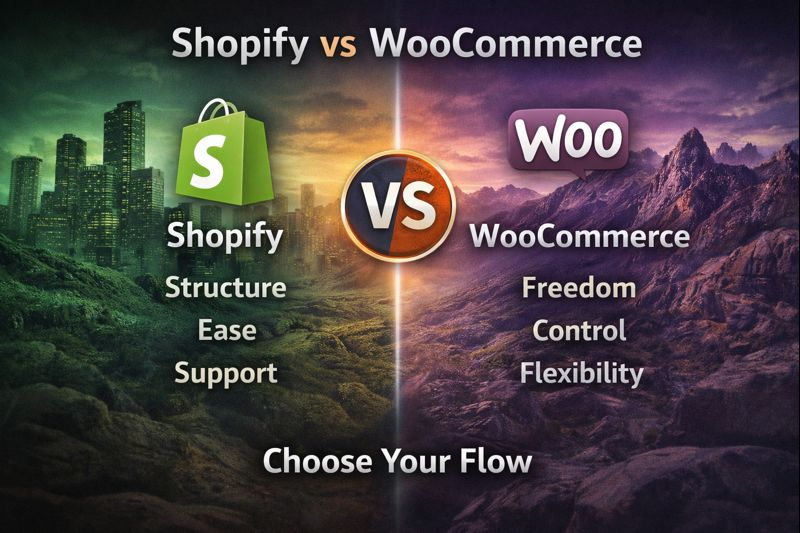
Choosing between Shopify and WooCommerce is all about catering to your store’s needs. Shopify offers simplicity, structure, and quite reliable support through Shopify’s support team. WooCommerce offers freedom, control, and customization. However, it has to be powered by WooCommerce experts.
Your success will depend not just on the platform. It depends on how wisely you use it. It depends on how you market, serve customers, and evolve with your audience.
At Vserveecommerce, our Shopify website designers and WooCommerce experts help businesses to build their digital stores. We build, optimize, and scale eCommerce stores that are functional and also future-ready.
For a smooth Shopify store or a powerful WooCommerce experience, we build what fits your business soul.
Talk to Vserveecommerce today.
Suggested Reads
https://www.vserveecommerce.com/blog/top-10-woocommerce-development-services/ – Best services for building powerful WooCommerce stores.
https://www.vserveecommerce.com/blog/essential-woocommerce-development-tools-for-2025/ – Tools every WooCommerce developer should know and use.
https://www.vserveecommerce.com/blog/woocommerce-expert-user-experience/ – How experts improve UX in WooCommerce stores.
https://www.vserveecommerce.com/blog/boost-sales-tech-electronics-expert-woocommerce-development/ – Driving electronics sales using WooCommerce expertise.

