


Last updated on April 2nd, 2026
The internet has become less of a place and more of a habit. People don’t “go online” anymore; they live there, scroll there, shop there, and sometimes even decide what they want before they fully understand why. In this quiet shift, your eCommerce platform becomes more than software. It becomes the stage where your brand performs every single day.
When it is time to choose that foundation, two names naturally come into focus: Shopify and Magento eCommerce solutions. Both have earned their place, and both deliver results. But they are shaped by different ideas. Shopify leans toward ease and quick movement, while Magento is built for flexibility and deeper control.
Magento holds around 7–8% of the global eCommerce platform market share. This shows it’s still one of the top platforms globally, especially strong in mid-to-large businesses. On the other hand, Shopify holds around 10.3% of the global eCommerce platform market share.
This guide slows things down just enough to help you see the real differences, so you can choose what actually fits your business.
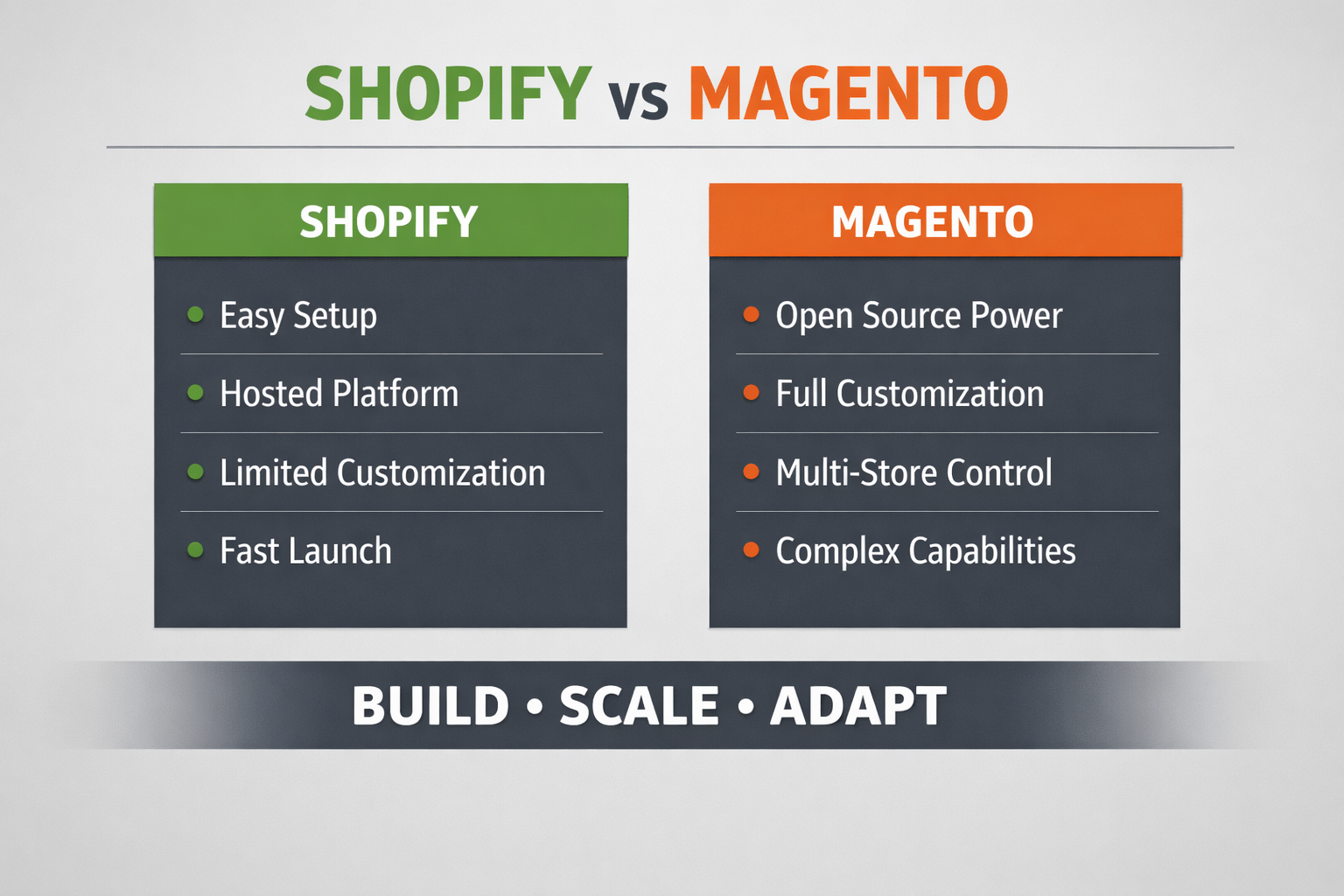
Ten Differences between Magneto and Shopify
1. Cost Of Ownership
Let’s start with money. Shopify begins at around $29/month. Here, hosting is included, and security is handled. You pay, and things work.
Magento eCommerce solutions is an open-source version that is free. However, you will pay for hosting, security, development, maintenance, and more.
For enterprise businesses, Magento eCommerce solution provides flexibility that can actually reduce long-term costs. Especially when scaling becomes serious. Shopify, at scale, can become expensive with apps and transaction fees quietly stacking up. So the question is not “which is cheaper,” but “which cost structure fits your growth rhythm.”
2. Platform Customization with Magento eCommerce Solutions
With Magento, you get to shape your store as you wish. Because it is open-source, Magento eCommerce solutions allow full access to the code. You can stretch it and rebuild it entirely. Want a strange checkout flow or a complex backend logic? It is possible with Magento.
Shopify, in contrast, does not give you that flexibility. You can change the decoration, but you cannot redesign its skeleton.
For brands that want uniqueness, Magento wins. This is why many businesses look for Magento developers or even consider hiring Magento developers with specialized experience.
And now, a new layer has emerged: AI-focused Magento development agencies. These agencies integrate AI-driven personalization, smart recommendations, and predictive analytics directly into Magento builds, making stores feel almost intuitive.

3. Product Flexibility with Magento eCommerce Solution
Products are rarely simple anymore.
Magento eCommerce solution provides support for:
- Simple products
- Configurable products
- Bundled products
- Virtual and downloadable items
It handles complexity with calm confidence.
Shopify does support variants and options, but it prefers simplicity. If your catalog is straightforward, Shopify feels smooth. If your products are layered, technical, or customizable, Magento feels a more natural choice.
4. Managing Multiple Stores
Running one store is easy. But running five to ten of them requires a lot of skill. Magento eCommerce development services shine here. With one admin panel, you can manage multiple stores. All your different domains and different catalogs remain connected.
Shopify, however, treats each store separately. There are separate logins and separate systems. It works, but it feels fragmented. If you are building a multi-brand empire, Magento website development company experts will almost always suggest this platform.

5. B2B eCommerce Features of Magento eCommerce Solutions
B2B is not just “bulk selling.” It is layered, negotiated, and structured.
Magento eCommerce solutions come with built-in B2B features:
- Custom pricing and quotes
- Role-based accounts
- Bulk ordering systems
- Advanced order workflows
Shopify can do B2B, but mostly through apps. It works, but it feels like adding extensions to something not originally designed for it. Magento, on the other hand, was built with this complexity in mind.
6. Customer Group Segmentation
Not all customers should see the same store.
Magento allows deep segmentation:
- By purchase history
- By geography
- By behavior
- By custom attributes
This means you can have personalized pricing, targeted promotions, and tailored experiences. Shopify offers segmentation, but often, it is through third-party apps. Though functional, it may not always be seamless.
7. International eCommerce (Magento Website Development Company Insights)
When you sell globally, you need currency conversion. Magento allows localization.
Magento lets you have:
- Multiple regional stores
- Different languages
- Local pricing strategies
- Region-specific catalogs
Shopify supports international selling, but its structure is still mostly single-store focused. For businesses thinking globally from day one, Magento eCommerce solutions feel more aligned.
8. Selling High-Risk or Controversial Items
Magento takes a flexible approach. If it is legal, you can sell it. Shopify has strict policies. Certain products, like firearms or regulated goods, are restricted.
This difference matters more than people expect. It can define entire business models.

9. PCI Compliance and Security
Shopify handles security for you. PCI compliance is built-in, and you do not think about it.
Magento gives you control, but security is your responsibility. You must manage compliance, security patches, and infrastructure. For some, this is a burden. For others, it is freedom.
10. Developer Availability and Expertise (Hiring Magento Developers)
Shopify developers are easier to find, as this ecosystem is large. Magento developers are fewer but often more specialized. Hiring Magento developers may cost more, but they bring deeper technical control.
With the rise of AI-focused Magento development agencies, Magento development is becoming even more advanced, blending traditional eCommerce with intelligent automation.
FAQs
1. Which platform is better for beginners?
Shopify is easier to start with because everything is managed and simple.
2. Is Magento still relevant in 2026?
Yes, Magento eCommerce solutions are widely used for large and complex stores.
3. Do I need developers for Magento?
Yes, most businesses rely on Magento developers for setup and maintenance.
4. Can Shopify handle large businesses?
Yes, but costs and limitations may increase as you scale.
5. What is the biggest advantage of Magento?
Magento gives you flexibility and control over every aspect of your store.
Conclusion
When you compare Shopify and Magento development, there is no universal winner here. Shopify is smooth, guided, and almost effortless. It removes friction. Magento is powerful, flexible, and demanding. It gives control.
If your business is simple, fast-moving, and prefers convenience, Shopify fits. If your business is complex, evolving, and needs depth, Magento eCommerce solutions quietly become the better choice. The decision is less about features and more about how you want to build.
If you are still standing at the crossroads, unsure which path bends toward your goals, VserveeCommerce is ready to help.
As a trusted Magento website development company and Shopify expert agency, VserveeCommerce offers tailored eCommerce design, Magento eCommerce development services, and advanced solutions powered by modern technologies. Do not just choose a platform. Build something that lasts.
Suggested Reads
https://www.vserveeCommerce.com/blog/electronics-eCommerce-magento-commerce-development-performance-testing/ – Performance testing strategies for high-demand electronics eCommerce Magento stores
https://www.vserveeCommerce.com/blog/magento-eCommerce-website-development-benefits/ – Key advantages of Magento for scalable eCommerce website development
https://www.vserveeCommerce.com/blog/top-10-shopify-development-services/ – Overview of essential Shopify development services for growing businesses
https://www.vserveeCommerce.com/blog/shopify-fulfillment-upgrade/ – Insights into Shopify fulfillment upgrades improving logistics and delivery efficiency