


Last updated on February 18th, 2026
Magento eCommerce is a platform that brings to life thousands of online stores across the globe. From small boutique brands to enterprise giants, businesses continue to rely on the Magento eCommerce solution when they need flexibility and strength. Backed by Adobe, Magento 2 remains one of the most structured and scalable systems in recent times.
Adobe is known worldwide for digital experience and marketing technologies. It has reshaped Magento after its acquisition. The result was Magento 2, a faster, cleaner, more modular, and more future-ready platform. Here, the changes were less cosmetic and more architectural.
If you want freedom with responsibility in your eCommerce processes, Magento is the answer. Magento holds a measurable share of the ecommerce platform market, capturing about 7–8 % of global ecommerce platform usage, making it one of the top three ecommerce platforms alongside Shopify and WooCommerce.
Table Of Contents
Advantages of Magento 2 Commerce and the Magento eCommerce Platform
Pricing Models of Magento eCommerce Solution
Two Major Variants of Magento 2
Customer Support in Magento eCommerce Solution
Payment Gateways in Magento eCommerce Platform
Limitations of Magento eCommerce Solution
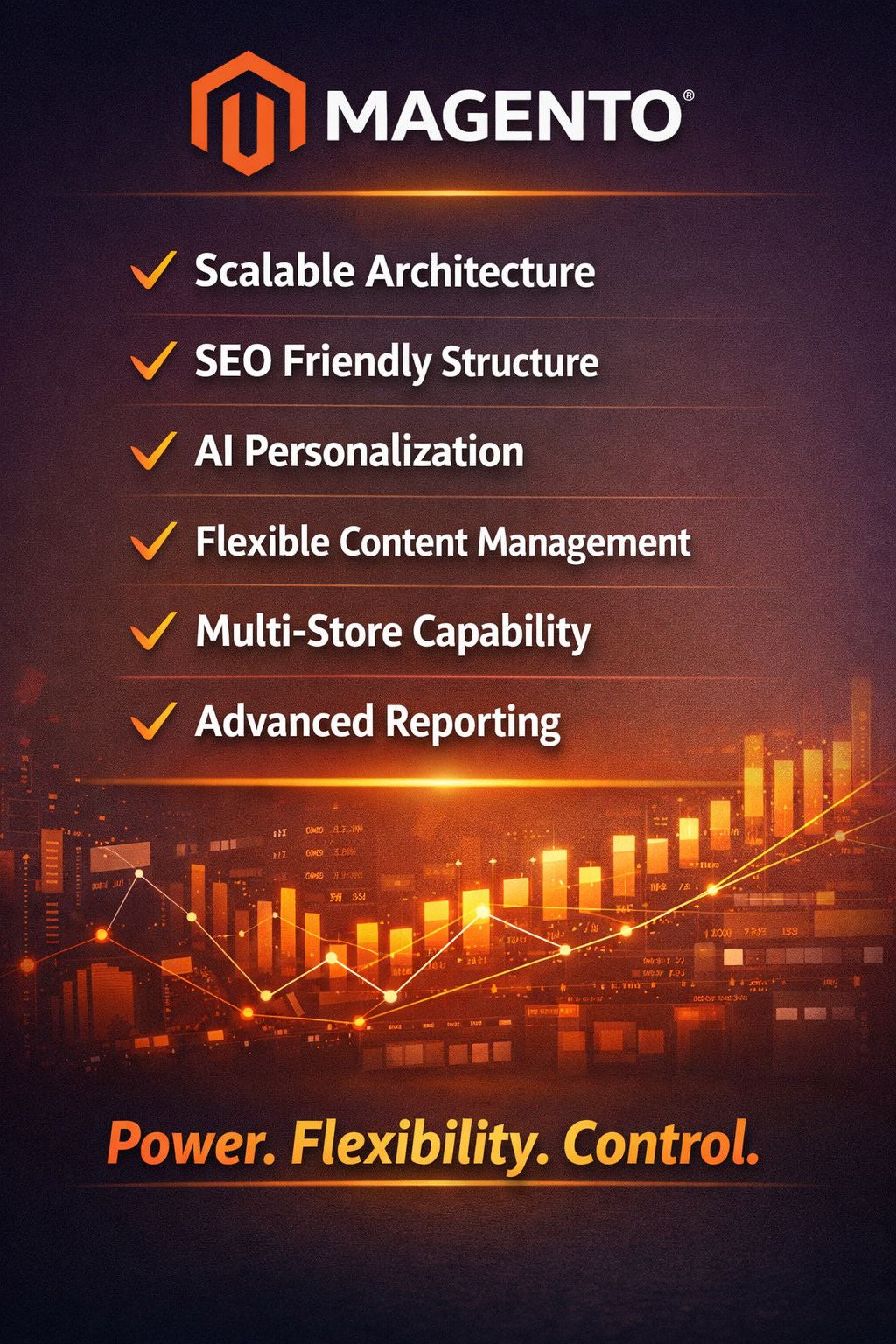
Advantages of Magento 2 Commerce and Magento eCommerce Platform
The Magento eCommerce solution is known for its robust structure. It is not lightweight software. It is a layered and quite customizable platform built for heavy-duty commerce.
1. Robust Platform
Magento 2 gives you the power to build a store with advanced features. There are multi-store capabilities, navigation at different levels, and deep product categorization. You can customize Magento’s eCommerce solution almost without limits if you have the right technical support.
Be it large catalogs, complex pricing rules, or multiple currencies, Magento handles them quite adeptly.
2. SEO Friendly
Search engines favor quite structured platforms. The Magento eCommerce platform offers SEO-friendly URLs, meta tags, XML sitemaps, canonical tags, and schema integration.
Organic growth becomes much easier when technical foundations are quite strong. That foundation is given by Magento.
3. Faster Loading and Performance
Magento 2 has improved its performance quite significantly compared to its earlier version. Magento understands that customers leave quickly when speed is an issue. With proper hosting, caching, and CDN integration, stores can load dramatically faster now. Adobe Commerce Cloud also provides quite optimized infrastructure options.
4. Flexible Content Management
Content drives conversions. Magento allows merchants to create dynamic landing pages. They can manage blocks and build promotional campaigns with flexibility. Page Builder tools in Adobe Commerce make visual editing much simpler than before. When you have flexible content management, you are not boxed in. You can shape the store as your brand demands.

5. Advanced Reporting And Analytics
Data is like a teacher of eCommerce. Magento provides detailed sales reports, customer behavior tracking, abandoned cart analysis, and performance dashboards.
When this information is combined with Adobe Analytics or third-party tools, you get much deeper insights. Since decisions become data-backed, they provide much better results.
Pricing Models of the Magento eCommerce Solution
The Magento eCommerce solution is powerful. However, this power comes with a cost. Businesses must evaluate carefully before stepping in.
Magento pricing depends on various factors. It depends on the version you choose, the hosting model, and the development scope. It is not as easy as a plug-and-play website builder. It requires quite some planning.
Licensing, hosting, development, maintenance, and integrations all contribute to the final budget. Choosing the right Magento eCommerce solution provider or Magento eCommerce solution company is important here. If you choose the wrong planning, it increases costs quite quickly.
The Two Major Variants Of Magento 2
1. Magento Open Source (Community Edition)
Magento Open Source is free to download. That may sound quite easy, but it is not entirely simple.
Although there is no licensing fee, businesses still have to spend significantly. The costs include hosting, development, security patches, custom themes, and integrations. A realistic yearly budget often includes development retainers, infrastructure management, and performance optimization. This version gives freedom, but you must build your own support ecosystem.
2. Adobe Commerce (Formerly Magento Commerce)
Adobe Commerce is the enterprise-level edition. It is often referred to by businesses seeking a Magento 2 Commerce provider
Pricing begins at a higher tier and scales depending on gross merchandise value (GMV). It includes cloud hosting options, advanced B2B modules, AI-driven product recommendations, customer segmentation tools, and dedicated support.
For growing enterprises, this version can justify the investment. But it requires financial readiness and strategic alignment.

Customer Support in a Magento eCommerce Solution
Support differs between versions. Magento Open Source does not provide official technical support. You rely on community forums or your hired developers. That is why selecting a reliable Magento eCommerce solution company becomes quite critical.
Adobe Commerce customers receive structured support directly from Adobe. This includes technical assistance, updates, and security patches. If your business depends heavily on uptime and performance stability, support should not be much of an afterthought.
Payment Gateways in the Magento eCommerce Platform
The Magento eCommerce platform supports major payment gateways by default and through integrations. PayPal, credit card processing, Braintree, Stripe, Amazon Pay, and region-specific gateways can be integrated quite smoothly.
This flexibility ensures customers can pay the way they prefer. And when payments are quite smooth, customers like to come back again and again.
Magento also supports multi-currency transactions and localized tax configurations. Global sellers find this quite an important factor.
Limitations of the Magento eCommerce Solution
Magento is quite powerful, but it is not effortless. The system is complex and requires experienced developers to install, customize, test, and maintain. Customization takes time, and upgrades require planning. Poor coding can slow performance quite dramatically.
Security maintenance must be quite consistent. Patch management is not optional. If you lack technical resources, working with a skilled Magento 2 Commerce provider becomes necessary. Otherwise, the platform may feel quite overwhelming.
Magento is not ideal for businesses looking for an instant setup with minimal involvement. It rewards those willing to invest effort.

Additional Insights for 2026
In 2026, Magento continues to evolve as a quite powerful and flexible commerce platform. It is adapting to the growing demands of modern online businesses.
1. AI-Powered Personalization
Magento leverages advanced AI tools to deliver much smarter customer experiences. They range from automated product recommendations and intelligent product sorting to quite precise customer segmentation. AI helps brands create shopping journeys that improve engagement and increase conversions.
2. Headless Commerce Architecture Support
Magento supports headless commerce. It means it allows businesses to separate the frontend from the backend. This separation gives brands much greater creative freedom in designing user experiences. Besides, you get much faster performance and seamless functionality across devices and platforms.
3. API-First Integrations
With its API-first approach, Magento enables smooth integration with third-party tools. These could be CRM systems, ERP software, payment gateways, or marketing platforms. This flexibility allows businesses to build a fully connected commerce ecosystem that scales with growth.
4. Progressive Web App (PWA) Capabilities
Magento’s PWA capabilities enhance mobile shopping. It delivers app-like speed, responsiveness, and reliability directly through the browser. This improves user experience, reduces bounce rates, and increases customer retention without requiring a native mobile app.
5. Strong B2B Functionality
Magento offers quite robust B2B features. These include custom pricing, bulk ordering, company accounts, streamlined approval workflows, and more. These capabilities make it quite an ideal solution for wholesalers, manufacturers, and enterprise-level businesses.
Overall, Magento has evolved beyond a simple shopping cart. It has matured into quite a comprehensive commerce framework. This is a solid framework that empowers businesses with benefits like scalability, flexibility, and advanced digital capabilities.
FAQs
1. What makes the Magento eCommerce solution quite different from other platforms?
Magento offers high customization, scalability, and enterprise-level features that many basic platforms cannot provide.
2. Is Magento suitable for small businesses?
Yes, it is suitable for all businesses. However, small businesses must assess development costs and technical requirements carefully before choosing it.
3. Can I customize Magento’s eCommerce solution fully?
Yes, Magento is highly customizable. Professional developers are usually required for Magento customization.
4. What is the role of a Magento eCommerce solution provider?
A Magento eCommerce solution provider can handle your Magento development, customization, performance optimization, and long-term maintenance.
5. Is Adobe Commerce much better than Magento Open Source?
Adobe Commerce offers more advanced features and official support. This makes it quite suitable for larger enterprises.
Conclusion
The Magento eCommerce platform remains one of the strongest players in digital commerce today. It offers flexibility, depth, and technical strength that only a few platforms can match. However, it demands skill, planning, and investment.
If you want total control over architecture, invest in Magneto. You get scalable infrastructure, advanced marketing tools, and enterprise-grade reporting. The Magento eCommerce solution can be quite a powerful ally to your business. But enter with awareness and with the right team.
If you are considering implementing or upgrading your Magento store, connect with Vserveecommerce. We are a trusted Magento eCommerce solution provider and Magento eCommerce solution company. Our experienced team can help you customize Magento’s eCommerce solution according to your business goals. We will help you optimize performance for seamless growth.
Reach out to Vserveecommerce today.
Suggested Reads
https://www.vserveecommerce.com/blog/magento-ecommerce-website-development-benefits/ – Key advantages of Magento website development explained
https://www.vserveecommerce.com/blog/devops-and-testing-tools-for-magento-development/ – DevOps tools improving Magento testing and deployment
https://www.vserveecommerce.com/blog/how-ai-magento-agencies-balance-automation-and-strategy/ – AI strategies used by modern Magento agencies
https://www.vserveecommerce.com/blog/magento-website-crashing-high-traffic-events/ – Prevent Magento crashes during peak traffic